Khiva Travel Guide: Itchan Kala, Sights and Getting There
Plan your trip to Khiva: what to see in Itchan Kala, the best sunset view, desert fortresses nearby, how to get there from Tashkent or Bukhara and how many days you need.
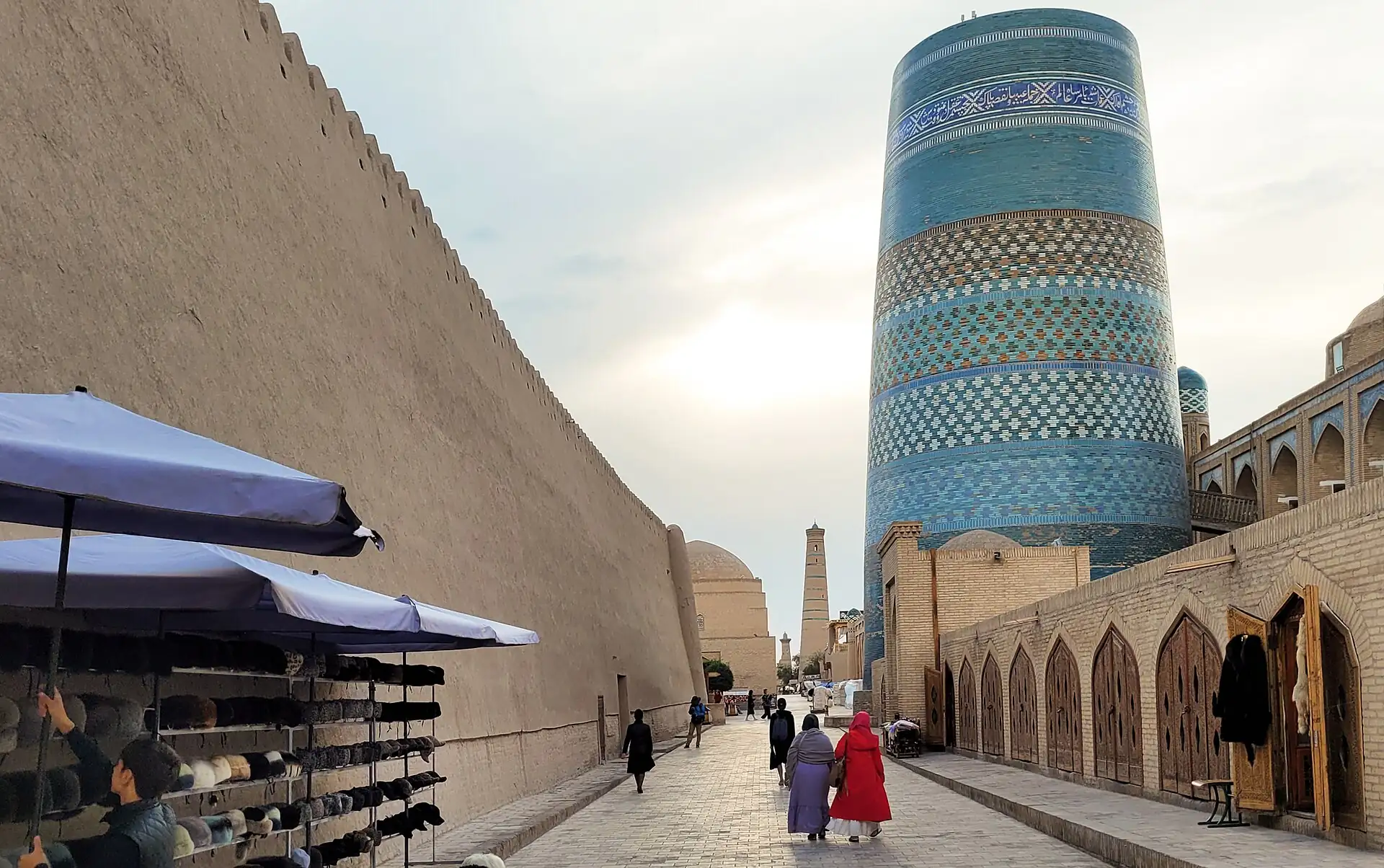
Khiva is a small city in western Uzbekistan whose old centre, Itchan Kala, is a complete walled town of mosques, madrasas, minarets and palaces that you can cross on foot in a quarter of an hour. This Khiva travel guide covers the main sights, the best things to do in Khiva after dark and in the desert nearby, how to get there and how many days to plan.
What is Itchan Kala?
Itchan Kala (Ichon Qal’a, “the inner fortress”) is the walled old town of Khiva. In 1990 it became the first place in Uzbekistan on the UNESCO World Heritage list. Its mud-brick walls run for more than two kilometres around a compact grid of lanes, with a gate on each side.
Most buildings date from the 18th and 19th centuries, when Khiva was the capital of a khanate. Many are now small museums, and the madrasa cells hold craft workshops and souvenir stalls. People still live inside the walls. Start with our page on Itchan Kala.
The combined ticket
Most visitors enter through the western gate, Ota Darvoza, where the ticket office sells a combined ticket for most of the museums and monuments inside the walls. A few extras, such as climbing the Islam Khoja minaret or the Kunya Ark watchtower, are usually paid separately. Prices and what is included change, so ask at the office, and keep the ticket with you: staff check it at each museum.
Things to do in Khiva: the main sights
Kalta Minor
The short, wide minaret covered in turquoise and green tiles just inside the west gate is the symbol of Khiva. Muhammad Amin Khan began it in the 1850s and wanted it to be the tallest minaret in Central Asia, but work stopped after his death and it was never finished. Read more about Kalta Minor.
Islam Khoja minaret
The tallest minaret in Khiva was built in the early 20th century, together with a small madrasa, by Islam Khoja, a grand vizier of the khanate. You can climb it: the stairs are narrow, steep and dark, but the top gives a view over the domes, the walls and the desert. Use your phone torch on the way up.
Juma Mosque
The Juma (Friday) Mosque has no grand portal or dome. It is one large hall with a flat roof held up by more than 200 carved wooden columns. The building is from the late 18th century, but some columns are much older and came from earlier mosques. See the Juma Mosque of Khiva.
Kunya Ark and the sunset view
The Kunya Ark, just inside the west gate, was the fortress and residence of the khans. Inside are the throne courtyard, a summer mosque with blue and white tiles and the old mint.
Its watchtower on the city wall is the classic sunset spot: the whole of Itchan Kala lies in front of you as the domes and minarets catch the last light. The platform is small, so go up about 45 minutes before sunset.
Tash Hauli
Tash Hauli (“stone house”) is the palace of Allakuli Khan, built in the 1830s. The harem courtyard has tall carved wooden pillars and walls of blue majolica tiles, and in the reception courtyard there is a round platform where the khan set up a yurt for guests.
Pahlavan Mahmud mausoleum
Pahlavan Mahmud was a poet, wrestler and furrier of the 13th–14th centuries and is the patron saint of Khiva. His mausoleum under a turquoise dome has a richly tiled interior. It is a place of pilgrimage, so dress modestly and keep your voice down.
Also worth a look: the large Muhammad Rahim Khan and Allakuli Khan madrasas, and the Nurullaboy palace in Dishan Kala, the outer town.
Walking the walls and Khiva in the evening
A stretch of the city wall near the north gate is open to walk on; go in the early morning or late afternoon, when it is cooler.
Evenings are one of the best things about Khiva. Day groups leave in the late afternoon, the lanes go quiet and the monuments are lit up. In season there are folk music and dance shows in madrasa courtyards, sometimes with dinner, and you will probably see the fast, cheerful Khorezm dance lazgi. See the Khiva evening of song and dance.
Try the local dishes too: shivit oshi, green noodles made with dill, and tuhum barak, dumplings filled with egg.
Desert fortresses and yurt camps near Khiva
Across the Amu Darya river, in the desert of Karakalpakstan and northern Khorezm, stand dozens of ruined mud-brick fortresses of ancient Khorezm, some more than 2,000 years old. A day trip by car from Khiva usually covers two or three:
- Ayaz Kala — a hilltop fortress with wide views over the desert; the climb takes about 15–20 minutes.
- Toprak Kala — the remains of a palace city, a seat of the Khorezm kings in the first centuries AD.
- Kyzyl Kala — a small, partly restored fort, often a stop on the way.
There is no public transport, so hire a driver or join a tour, and plan on about 1.5–2 hours' drive each way. More on Ayaz Kala and Toprak Kala.
Near Ayaz Kala there is a yurt camp where you can spend the night, eat a simple dinner and watch the stars: see our desert yurt stay. With more time, continue to Nukus and its famous art museum in Karakalpakstan.
How to get to Khiva
By air
The nearest airport is in Urgench, about 30–35 km from Khiva; a taxi takes about 30–40 minutes. There are domestic flights from Tashkent and a few international routes. Schedules change, so check before you travel.
By train
Khiva has its own railway station a short walk from the old town walls. Overnight sleeper trains run from Tashkent, and day trains link Khiva with Bukhara (about 6–7 hours) and Samarkand. Some trains stop at Urgench instead. See our guide to trains in Uzbekistan. Many travellers take the train one way and fly the other.
By road from Bukhara
The road from Bukhara crosses the Kyzylkum desert and follows the Amu Darya for part of the way. It is about 450 km, or about 6–7 hours by car, with few places to stop, so bring water and snacks. Coming from Bukhara? See things to do in Bukhara.
How many days do you need in Khiva?
- 1 day: enough for the main sights if you arrive the evening before, but rushed.
- 2 days: best for most people: the old town at a relaxed pace, a minaret climb, sunset from the Kunya Ark and an evening show.
- 3 days: add the desert fortresses or a night in a yurt camp.
Best time to visit Khiva
The best months are April–May and September–October. Summers in Khorezm are very hot, often above 40 °C in July and August, with little shade in the old town, so sightsee in the morning and evening and rest at midday. Winters are cold and frosty, but quiet. More in our guide to the best time to visit Uzbekistan.
FAQ
Is Khiva worth visiting?
Yes. Itchan Kala is one of the best-preserved walled old towns in Central Asia, and it is small enough to explore easily on foot.
Can you visit Khiva as a day trip?
From Urgench, yes, it is only 30–40 minutes away. From Bukhara or Samarkand it is too far, so plan at least one night.
Do you need a ticket for Itchan Kala?
Yes, a combined ticket sold at the west gate covers most museums and monuments inside the walls. Some extras, like the minaret climb, cost a little more.
How far is Khiva from Urgench airport?
About 30–35 km, or 30–40 minutes by taxi.
Can you stay inside Itchan Kala?
Yes. There are guesthouses and small hotels inside the walls and many more just outside the gates.
Plan your trip
Find sights, hotels and tours on our Khiva destination page, or let our AI trip planner build a route that links Khiva with Samarkand and Bukhara.