15 Best Things to Do in Samarkand: A Travel Guide
The best things to do in Samarkand: Registan by day and night, Gur-e-Amir, Shah-i-Zinda, bazaars, a plov class and day trips, plus how many days to stay and how to get there.
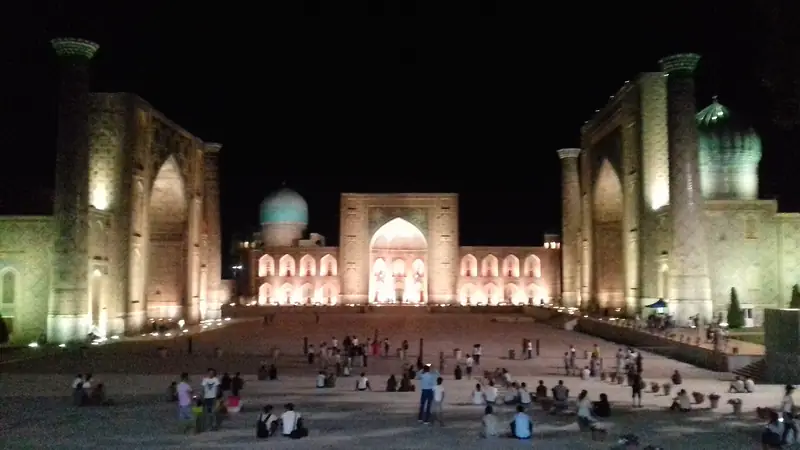
The best things to do in Samarkand are seeing the Registan by day and lit up at night, visiting Timur's tomb at Gur-e-Amir, walking the blue-tiled lane of Shah-i-Zinda and shopping at Siab Bazaar. Add a paper mill, a plov class and a day trip to Shakhrisabz, and two or three days fill up easily. This Samarkand travel guide lists 15 attractions and experiences, with practical tips for each.
The main Samarkand attractions
Samarkand's old centre is on the UNESCO World Heritage List as "Samarkand – Crossroad of Cultures". Most big sights are a short walk or taxi ride apart.
1. See the Registan by day
The Registan is the square every visitor comes for: three madrasas facing each other — Ulugbek (15th century), Sher-Dor and Tilya-Kori (both 17th century). You can see the facades from the edge of the square, but you need a ticket to walk inside the courtyards, where old student cells now hold craft shops.
- Do not miss the gilded prayer hall inside Tilya-Kori.
- Look up at the Sher-Dor portal, with its tiger-like lions chasing deer.
2. Watch the Registan at night
After dark the madrasas are lit up, and sitting on the steps facing them costs nothing. On some evenings there is also a sound and light show projected onto the facades. It does not run every night and the schedule changes, so ask your hotel on the day.
3. Visit Gur-e-Amir, the tomb of Amir Timur
Gur-e-Amir is the ribbed blue-domed mausoleum where Amir Timur (Tamerlane) is buried with his grandson Ulugbek and other members of the dynasty. Timur's tombstone is a block of dark green jade, and the walls inside are covered in gold and blue patterns. It is about 10 minutes' walk from the Registan.
4. Walk up the Shah-i-Zinda necropolis
Shah-i-Zinda is a narrow lane of mausoleums climbing a hillside, most from the 14th and 15th centuries, with some of the finest tilework in the city. The name means "the living king" and refers to Kusam ibn Abbas, a cousin of the Prophet Muhammad, who is said to be buried here.
It is a pilgrimage site, so cover shoulders and knees (women may want a scarf) and keep your voice down. Morning and late afternoon light is best for the tiles.
5. Stand under Bibi-Khanym Mosque
Timur built Bibi-Khanym around 1400, after his campaign in India, as one of the largest mosques of its time. Much of it collapsed and was rebuilt in the 20th century, but the scale is still impressive. It stands at the end of the pedestrian street from the Registan.
6. Shop and snack at Siab Bazaar
Siab Bazaar is right next to Bibi-Khanym. It is a working market, not a show for tourists: dried fruit, nuts, spices, halva, fresh fruit in season and, above all, Samarkand bread. Vendors will offer you a taste; it is fine to try and walk on.
7. See where Ulugbek studied the stars
Ulugbek was a ruler and an astronomer. At the Ulugbek Observatory, built in the 1420s, you can see the underground part of the huge arc he used to measure the positions of the stars, and a small museum about his work. A visit takes under an hour.
8. Visit the Afrosiab Museum
The hill of Afrosiab, just north of today's centre, is the site of ancient Samarkand, destroyed by the Mongols in the 13th century. Its museum holds 7th-century wall paintings of a Sogdian king receiving foreign envoys — a rare look at Silk Road life before Islam.
Crafts, food and everyday life
9. Watch silk paper being made in Konigil
At the Konigil paper mill, in a village just outside the city, craftsmen make traditional Samarkand paper from mulberry bark with a water-driven mill. You can watch every step and buy notebooks in the shop. The shady garden by the stream is a nice break in summer.
10. Try Samarkand bread
Samarkand non is famous across Uzbekistan: round, heavy, glossy and dense, and it stays fresh for days. Buy one hot from a bakery or at Siab Bazaar; some bakeries let visitors watch or try baking.
11. Take a plov cooking class
Plov is the national dish, and Samarkand plov is usually cooked in layers rather than stirred, with the meat placed on top. In a plov cooking class you cut the carrots, cook in a big kazan with a local family or chef and eat the result together.
12. Walk the old city
Behind the main monuments are the mahallas — quarters of narrow lanes, courtyard houses and small mosques. The old Jewish quarter near the Registan is one of the most interesting. A guided walk helps, because the stories are not on any sign.
13. Visit the Eternal City
The Eternal City is part of the newer Samarkand Silk Road tourist complex on the edge of town: a recreated old town with craft workshops and food stalls. It is new, not historic, but pleasant for an evening walk.
Day trips from Samarkand
14. Go to the Urgut bazaar
Urgut, about an hour's drive away, has one of the region's biggest weekend markets, best known for suzani — hand-embroidered textiles, old and new. Go early on Sunday, when it is busiest.
15. See Timur's hometown, Shakhrisabz
Shakhrisabz, Timur's birthplace, is about two hours away over a mountain pass. See the huge ruined gate of the Ak-Saray palace, the Kok Gumbaz mosque and the Dorut Tilovat complex. In winter the pass can close because of snow, and drivers take a longer road.
How many days do you need in Samarkand?
- 1 day: the Registan, Gur-e-Amir, Bibi-Khanym, Siab Bazaar and Shah-i-Zinda, plus the Registan at night. Tiring, but possible.
- 2 days: all the main sights at an easy pace, plus the observatory, Afrosiab and Konigil.
- 3–4 days: add a plov class, an old city walk and a day trip to Urgut or Shakhrisabz.
Where to stay in Samarkand
Staying near the Registan or Gur-e-Amir lets you walk to the main sights and rest in your room in the heat of the day. The old city has many small family guesthouses with courtyards; larger modern hotels are in the newer part of town and in the Silk Road complex. Compare options on our hotels page.
How to get to Samarkand
The easiest way is the Afrosiyob high-speed train: about 2–2.5 hours from Tashkent and 1.5–2 hours from Bukhara. Book early in spring and autumn, when it often sells out. See our guide to trains in Uzbekistan for tickets and classes. Samarkand also has an airport with domestic and some international flights; routes change, so check before you travel.
FAQ
Is Samarkand worth visiting?
Yes. The Registan, Gur-e-Amir and Shah-i-Zinda are among the finest Islamic monuments anywhere, and they are the reason many people come to Uzbekistan at all.
When is the best time to visit Samarkand?
Spring (April–May) and autumn (September–October) are the most comfortable, with warm days and cool evenings. Summer is very hot at midday, and winter is cold but quiet.
Can you visit the Registan for free?
You can see the madrasas from the edge of the square and enjoy the evening lights without a ticket. To enter the courtyards and the Tilya-Kori prayer hall you need one; prices change, so check on the spot.
Is Samarkand walkable?
The Registan, Gur-e-Amir, Bibi-Khanym, Siab Bazaar and Shah-i-Zinda are all within walking distance of each other. For the observatory, Afrosiab and Konigil, a taxi from an app such as Yandex Go is cheap and quick.
Should I visit Samarkand or Bukhara?
Both, if you can. Samarkand has the grander monuments, Bukhara's old town feels more like a living medieval city, and the Afrosiyob links them in under two hours.
Planning the rest of your trip? See our Samarkand destination guide for more places to visit, and continue west with the best things to do in Bukhara.